Will a stair lift fit your stairs?
Measure at the narrowest point, from the wall to the edge of the handrail.
1 of 3
Do your stairs go straight up, or do they turn?
2 of 3
Does the rider weigh more than 300 lb?
3 of 3
Answer three quick questions to see which lifts fit.
- Planning guide, straight
- 28 in Stannah general guide
- Planning guide, turning
- 30 in Stannah general guide
- Narrowest listed
- 26 in Acorn 130
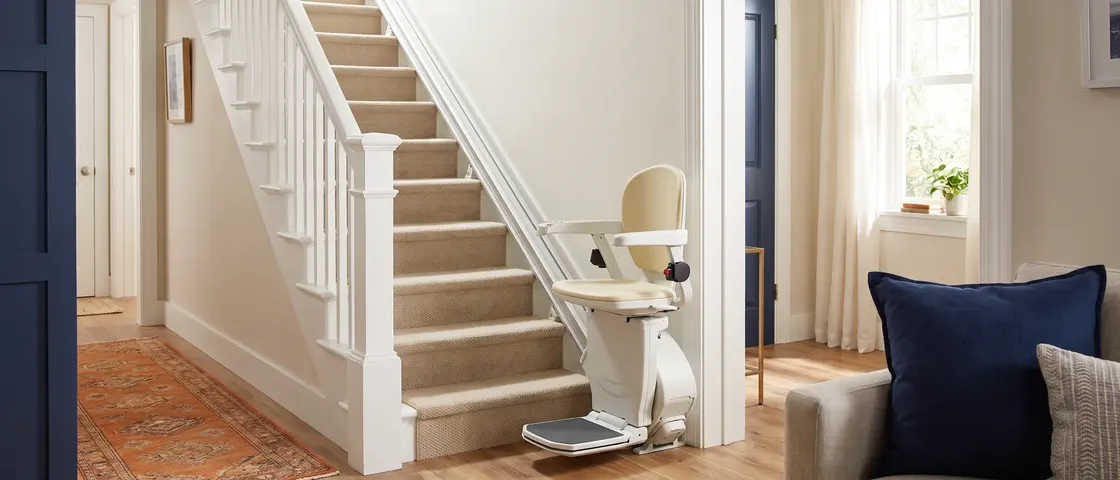
Narrowest stairs and folded depth, model by model
Folded depth is how far the parked lift sticks out from the wall; the installer confirms the fit on the visit.
| Model | Stairs | Narrowest stairs | Folded, from wall | Weight limit | Installed price |
|---|---|---|---|---|---|
 Acorn 130Sources: specifications · pricing | Straight | 26 in manufacturer's figure | 12¼ in | 280 lb heavy-duty version: 350 lb | $3,000–$5,000 estimate from review sites |
 Stannah Siena 600Sources: specifications · pricing | Straight | 27 in manufacturer's figure | 14½ in | 350 lb | $4,700 published: the manufacturer's installed price |
| Acorn 180Sources: specifications · pricing | Curved | 27½ in manufacturer's figure | 13¼ in | 265 lb | $8,000–$15,000+ estimate from review sites |
| Stannah Siena 260Sources: specifications · pricing | Curved | 30 in manufacturer's figure | 16 in | 300 lb heavy-duty version: 352 lb | $10,800 published: the manufacturer's installed price |
 Harmar Pinnacle SL600Sources: specifications · pricing | Straight | ≈ 28 in usual guide | 10½ in | 350 lb | $5,380 published: lift + fitting, one dealer |
 Savaria K2Sources: specifications · pricing | Straight | ≈ 28 in usual guide | 10¾ in | 350 lb | $4,135 published: lift + fitting, one dealer |
| Harmar Pinnacle SL300Sources: specifications · pricing | Straight | ≈ 28 in usual guide | 11 in | 300 lb | $4,365 published: lift + fitting, one dealer |
 AmeriGlide Rave 2Sources: specifications · pricing · installation | Straight | ≈ 28 in usual guide | 11 in | 350 lb | $2,749–$4,249 estimate: lift price + usual fitting |
 Bruno ElanSources: specifications · pricing · installation | Straight | ≈ 28 in usual guide | 12 in | 300 lb | $3,500–$5,000 estimate: lift price + usual fitting |
 Handicare 1100Sources: specifications · pricing · installation | Straight | ≈ 28 in usual guide | 12⅝ in | 310 lb | $3,799–$5,299 estimate: lift price + usual fitting |
| Bruno EliteSources: specifications · pricing · installation | Straight | ≈ 28 in usual guide | 15⅛ in | 400 lb | $5,499–$6,999 estimate: lift price + usual fitting |
| Handicare 1000Sources: specifications · pricing · installation | Straight | ≈ 28 in usual guide | 15¼ in | 350 lb heavy-duty version: 440 lb | $3,990–$5,490 estimate: lift price + usual fitting |
| Harmar Pinnacle SL600HDSources: specifications · pricing | Straight | ≈ 28 in usual guide | 16½ in | 600 lb | $8,230 published: lift + fitting, one dealer |
| Bruno Elite CurvedSources: specifications · pricing | Curved | ≈ 30 in usual guide | 15 in | 400 lb | $12,000–$25,000+ published: a dealer's installed range |
| Harmar HelixSources: specifications · pricing · installation | Curved | ≈ 30 in usual guide | 16 in | 350 lb | $11,495–$12,995 estimate: lift price + usual fitting |
| Handicare FreecurveSources: specifications · pricing · installation | Curved | ≈ 30 in usual guide | 16½ in | 275 lb | $10,499–$11,999 estimate: lift price + usual fitting |
Only Acorn and Stannah publish a minimum stair width for their models. ≈ marks the usual planning guide (28 in for straight stairs, 30 in for stairs that turn); the installer measures your stairs before quoting.
An installer checks the landings, doors and handrails on the visit.
The minimum stair width for a stair lift is about 28 inches for most straight models and about 30 inches for most curved ones. A few go narrower: Acorn's straight 130 fits 26 inches and its curved 180 fits 27.5. Your weight matters as well, so it helps to know both figures before you ask for a price estimate.
How Narrow Can Your Stairs Be for a Lift?
Stannah, a stair lift company, says stairs about 28 inches wide suit most straight lifts in most homes, and about 30 inches suit most curved ones. Lifeway Mobility, a company that installs lifts, plans on 28 to 30 inches for straight stairs, depending on the model.
Tight stairs do not mean you are out of options. Acorn says its 130 runs on stairs just 26 inches wide, and its 180 on stairs 27.5 inches wide, leaving the rider room to swivel the seat round. Stannah also sells a slim Siena chair that suits stairs as tight as 27 inches.
Here is a count of how many of the 16 lifts compared on this page work at each stair width: by a published minimum, or only by the usual guide, where the installer's measurement decides.
| Staircase width | Straight models expected to fit | Curved models expected to fit |
|---|---|---|
| 26 in | 1 published | none |
| 28 in | 2 published, 9 more by the usual guide | 1 published |
| 30 in | 2 published, 9 more by the usual guide | 1 published, 4 more by the usual guide |
| 32 in | 2 published, 9 more by the usual guide | 1 published, 4 more by the usual guide |
Smallest Stair Width Each Model Needs
Every manufacturer sets its own smallest stair width, so check the exact model you are considering. Folded depth means how far the lift juts out from the wall once the seat, the footrest, and the arms are all folded away and no one is riding. A lift with a small folded depth leaves more passing room for anyone using the stairs.
Some models offer a heavy-duty option with a higher weight limit, shown in the table. Looking at all 16 models together, 350 pounds is the middle weight limit. The heaviest rating, 600 pounds, goes to the Harmar Pinnacle SL600HD, and the lightest, 265 pounds, to the Acorn 180.
Is Your Staircase Suited to a Lift?
Stair width, staircase shape and the rider's weight are useful starting points for comparing models, rather than a guarantee that a lift will fit. If your stairs run straight with no landing or turn, a straight lift will do, and it costs less. Stairs with a bend need a curved lift, and most of those need at least 30 inches of width, though the Acorn 180 needs only 27.5.
Start with width, since it immediately rules models in or out. Stannah says a folded lift typically takes up about 7.5 inches of the stair width. The folded depths in the table measure how far the whole unit sticks out from the wall, and they run from 10.5 to 16.5 inches, so if others use the stairs, look for a smaller number.
Weight comes next. All 16 models have weight limits of at least 265 pounds, though stair width also affects your options. For riders over 400 pounds, the Handicare 1000 heavy-duty option supports up to 440 pounds, and the Harmar Pinnacle SL600HD supports up to 600 pounds.
Stair Lift Measurements to Take
Two measurements help you check which models might fit before anyone comes to the house.
- Measure the width of your stairs, so you can compare it with the narrowest stairs each model needs.
- Count your steps, because the rail length depends on the length of your staircase.
The rail is the track the seat travels along. Our cost tool estimates use a 15.5-foot standard rail and allow about $75 for each extra foot, and these are estimates, not terms that apply to every straight lift.
| Steps, straight stairs | Rail length | Price, new lift installed |
|---|---|---|
| 8 | roughly 10 ft | roughly $2,500–$5,000 |
| 13 | roughly 16 ft | roughly $2,575–$5,075 |
| 16 | roughly 19 ft | roughly $2,800–$5,300 |
| 20 | roughly 23 ft | roughly $3,100–$5,600 |
According to the National Council on Aging, having a new straight lift installed runs roughly $2,500 to $5,000, a curved one costs about $8,000 to $12,000, and a secondhand straight model goes for around $1,500 to $3,000.
What to Expect When an Installer Visits
Acorn provides quotes in your home. Other prices listed here are estimates, starting prices or prices from individual dealers.
Sometimes installation is included, and sometimes it costs extra. A single Harmar dealer quotes $725 for fitting the Pinnacle SL300, and a Savaria dealer asks $345 to $445 for fitting the K2. The AmeriGlide Rave 2 can be fitted yourself or installed by a paid installer. Curved lifts like the Harmar Helix are priced to your stairs.
Which Brands and Prices Are on This Page
The lifts covered on this page come from seven brands: AmeriGlide, Acorn, Bruno, Handicare, Harmar, Savaria, and Stannah. This page compares 11 straight lifts and five curved lifts.
Straight lift prices start at $2,249 with the AmeriGlide Rave 2 bought online and climb to roughly $7,505 for the Harmar Pinnacle SL600HD, both before installation; the model-by-model table gives the installed prices. Curved models begin near $8,000 and can top $25,000 for the Bruno Elite Curved. Warranty terms vary just as much: Acorn lifts carry a 12-month manufacturer's warranty, while the Bruno Elan is backed by a limited lifetime warranty.